
AI-native products, built to run in production
An AI demo takes a weekend. A product people rely on needs everything around the model: data pipelines, evaluation, cost control, a fallback when the model is wrong, and a backend that keeps it honest. We build products where AI is the core rather than a feature added later, and we've shipped one of our own, Oclo Trace.
"Man in a red shirt near the gate, last night"
- Footage
- 4 cameras, from the DVR
- Motion filter
- Quiet frames skipped
- People detection
- Running on this computer
- Image search
- Matched on this computer
- Close-up check
- Sent to cloud model
- Result
- Gate camera, 2:14 am
What we build
LLM workflows and agents
Multi-step workflows and agents that call your tools and APIs, with guardrails, retries and a log of what they did.
Search over your own data
Retrieval over documents, records and images, so answers come from your data and show where they came from.
Computer vision
Detection, tracking, OCR and image search on photos and video, running on the user's machine or in the cloud.
Private, on-device AI
Models that run on your own servers or users' computers when data shouldn't leave, with cloud models used only where they add accuracy.
Model choice and cost control
The right model for each step, from small open models to Claude, GPT or Gemini, with caching and limits so running costs stay predictable.
Evaluation and monitoring
Test sets built from real cases, accuracy measured before launch, and monitoring for accuracy, speed and cost once it's live.
Built and running in Oclo Trace
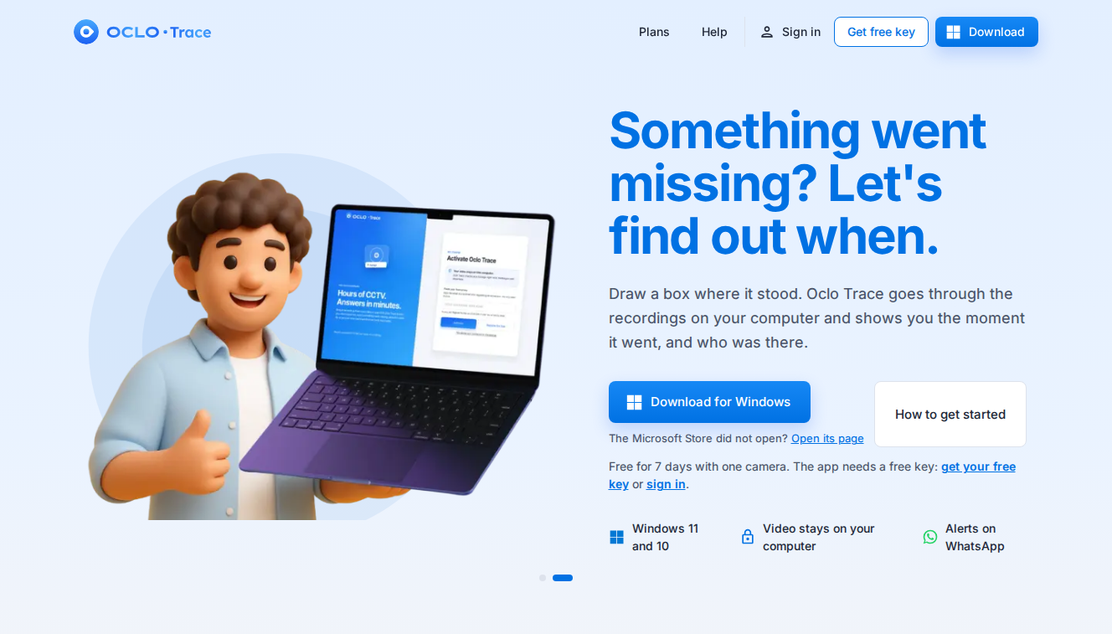
Oclo Trace is our own AI product. It searches recorded CCTV footage on the customer's Windows computer and finds the moment something happened in minutes, instead of hours of playback.
- Draw a box around something to find when it changed, or search in plain words like "man in a red shirt near the gate"
- Open models running locally for people detection, OCR and image search, using the GPU when there is one
- Footage from a pen drive, a folder, or straight from the DVR or NVR on the network
- Offline licences and alerts on WhatsApp
How we work
Scoping call
30 minutes on the problem, the data you have, and what a wrong answer would cost. We'll tell you honestly if we're the right fit.
Prototype on real data
A focused prototype on your own data proves the approach before the full build, with a fixed scope agreed up front.
Build in milestones
The application, backend and AI pipeline built in milestones you can test, with accuracy measured at each one.
Launch and measure
Live with monitoring for accuracy, speed and cost, then improved from real use.
Tell us what you need built
We'll scope it on a 30-minute call and tell you honestly if we're the right fit.
Frequently Asked Questions
What does AI-native product development mean?
Designing a product around what AI makes possible from the start, rather than adding a chatbot to an existing app. The data flow, the interface and the backend are all built for AI that is sometimes wrong, so it can be checked, corrected and measured.
Which AI models do you use?
Whichever fits each step. Oclo Trace, for example, runs open models locally for image search and OCR, and calls a cloud model only for the close-ups that need it. We work with Claude, GPT, Gemini and open-weight models.
Can AI run without sending our data to a cloud provider?
For many tasks, yes. Smaller models can run on your own servers or on users' computers. That's how Oclo Trace searches footage on the customer's own machine.
How do you know the AI is accurate enough?
We build a test set from real examples and measure accuracy before launch. Where a mistake would be costly, the product suggests and a person decides.
How much does an AI-native product cost?
It depends on the scope, so it's quoted after a 30-minute scoping call. We usually start with a fixed-price prototype on your data, so you see whether the approach works before committing to the full build.